













Artificial Intelligence is rapidly influencing nearly every industry, and education is no exception. While AI in schools once sounded futuristic, it is now becoming a practical tool that can support learning, communication, administration, and collaboration.
However, AI in education is not about replacing teachers or traditional classrooms. Instead, it is about improving how schools operate, communicate, and support students in a digital-first world.
As schools explore modern digital ecosystems, AI is beginning to play a meaningful role in shaping smarter educational experiences.
AI-Assisted Learning Is Changing Student Experiences
Students today learn differently from previous generations. They are more digitally connected, visually engaged, and accustomed to instant access to information.
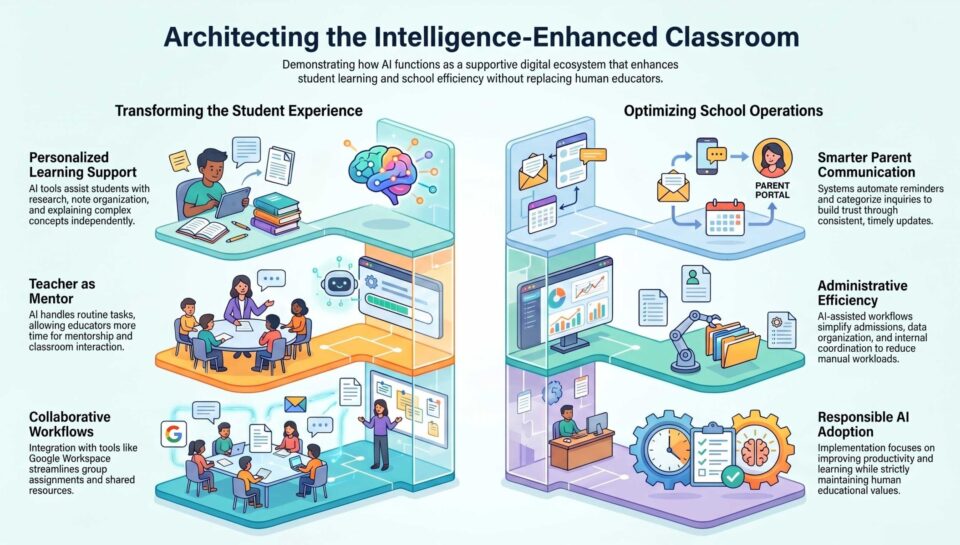
AI-powered educational tools can help personalize learning experiences by:
- Generating summaries
- Explaining complex concepts
- Supporting research
- Creating practice exercises
- Organizing notes
- Assisting with revision
Tools like AI-powered assistants and collaborative learning platforms can help students become more independent learners while still working under teacher guidance.
Rather than replacing educators, AI enables teachers to spend more time on mentorship, critical thinking, and classroom interaction.
Smarter Communication for Schools
Communication is one of the most important aspects of school management. Parents expect timely updates, clear announcements, quick responses, and organized information.
AI-assisted systems can help schools improve communication by:
- Organizing inquiries
- Automating reminders
- Categorizing requests
- Assisting with content generation
- Streamlining announcements
This reduces manual workload while improving responsiveness and consistency.
For schools managing growing parent communities, better communication directly contributes to stronger trust and satisfaction.
AI and Collaborative Learning Environments
Modern learning environments are increasingly collaborative. Students and teachers now work together using shared digital documents, cloud platforms, virtual classrooms, and connected systems.
AI tools combined with collaborative platforms such as Google Workspace for Education can create smarter workflows for:
- Group assignments
- Shared classroom resources
- Research projects
- Digital discussions
- Assignment organization
- Classroom coordination
This creates more connected and efficient learning experiences for both students and educators.
Administrative Efficiency Through Intelligent Systems
Schools often deal with repetitive administrative tasks that consume time and resources.
AI-assisted workflows can help simplify operations like:
- Admission inquiry management
- Data organization
- Communication scheduling
- Document handling
- Internal coordination
- Workflow tracking
Even small operational improvements can significantly reduce workload for administrative teams.
The goal is not full automation.
The goal is enabling schools to work more efficiently while focusing more on education and student development.
Responsible AI Adoption Matters
As AI adoption grows, schools must also think carefully about responsible implementation.
AI should be used to:
- Support educators
- Improve productivity
- Enhance learning experiences
- Simplify workflows
It should not replace human interaction, mentorship, or educational values.
Schools adopting AI thoughtfully and responsibly will likely gain long-term advantages in adaptability and innovation.
The Future Classroom Is Connected
The future classroom is likely to become increasingly connected, collaborative, and AI-assisted.
Students will continue using digital platforms not only for assignments but also for communication, research, teamwork, and personalized learning.
Schools that begin building modern digital infrastructure today will be better prepared for these changes tomorrow.
Future-ready education is no longer just about physical infrastructure.
It is also about digital readiness.
Conclusion
AI is gradually becoming an important part of modern education, not as a replacement for traditional teaching, but as a support system for smarter learning and better collaboration.
Schools that embrace AI-assisted systems thoughtfully can improve communication, simplify operations, strengthen learning experiences, and prepare students for a more connected future.
The schools that adapt early will likely shape the future of modern education.